If you played advanced piano before a long break, choose your first repertoire by testing what you can read, control, and return to comfortably today. A former exam level is useful background, but it cannot select the right piece on its own.
You may remember how a sonata should sound while finding that its opening no longer feels dependable. Or an old piece may come back surprisingly well until you try starting halfway through. The next step is to find out which parts of the playing are available and which need rebuilding.
This guide is for returning pianists with substantial previous study who want help choosing music. For a broader overview of restarting lessons and practice, begin with returning to piano as an adult.
Use three short samples to assess your starting point
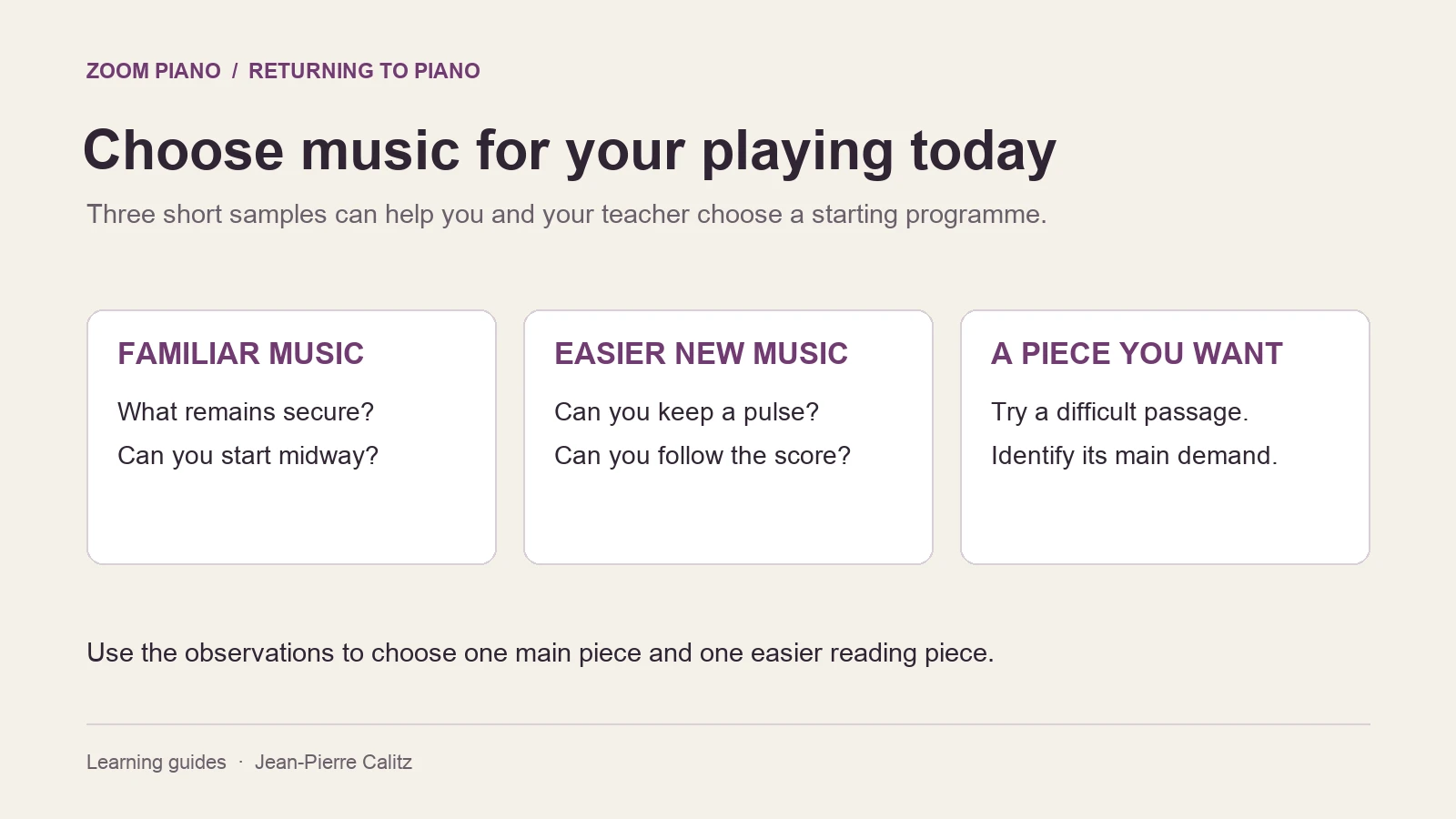
Bring three contrasting samples to a lesson, or make brief recordings for your own notes. Choose manageable passages rather than attempting a whole former recital programme.
- A familiar passage: use music you once knew well. Notice what you can explain from the score and what you can play only by continuing a remembered sequence.
- An unfamiliar, easier passage: choose a texture you can read slowly without constant stops. This helps separate current reading from memory of old music.
- A passage from a piece you want to learn: sample a demanding section, not just an inviting opening. Identify the specific task that makes it difficult.
For each sample, write down where the pulse stops, where the hands lose coordination, and whether you can hear the musical line you intend. Include what feels secure. The point is to choose the next task accurately, not to assign yourself a new grade after one session.
Describe the difficulty before deciding the level
“Too hard” can mean several different things. A passage might have difficult notation, unfamiliar movement, independent voices, or a dense texture that hides the melody. Those problems call for different work.
| What you notice | What to investigate | A useful feature in the next piece |
|---|---|---|
| You stop to decode most chords | Reading and recognition of patterns | A clear texture with recurring harmonic shapes |
| The notes are familiar but the melody disappears | Balance between musical layers | A manageable accompaniment under one clear melodic line |
| You can continue, but cannot restart in the middle | Dependence on a memorized sequence | Clear phrases and several identifiable starting points |
| Most sections work, but one repeatedly breaks down | The demand of that particular passage | A piece whose hardest passage is a realistic current task |
These observations are starting points for a teacher’s assessment. For example, trouble at a chord change may involve reading, fingering, or both. Avoid prescribing the same exercise for every hesitation.
Choose one main piece and one easier reading piece
For an initial programme, give each piece a job. Choose a main piece with musical substance and a specific skill to develop. Alongside it, use easier music that lets you read continuously and finish phrases. Keep a more ambitious favourite on a separate list while you test its demands.
The main piece should leave enough attention for sound, phrasing, and balance. If every session is consumed by working out the notes, choose a shorter work or a less demanding texture. That gives you room to practise the aspects of playing that made advanced music satisfying in the first place.
For the reading piece, choose music sufficiently accessible that you can maintain a deliberate pulse. The aim is to follow the score and continue through a phrase. When repeated stops become the main activity, simplify the selection.
Two contrasting pieces to audition
These examples give the assessment a concrete starting point. They are choices to discuss, not grade placements or a prescribed programme. A deliberately easier piece can reveal a useful musical task without becoming your main repertoire.
| Piece | What to try | When to defer it |
|---|---|---|
| Schumann: “Melodie,” Op. 68, No. 1 | Use the opening to test whether you can sustain a singing melody while keeping the accompaniment quieter. Record a phrase and listen for its destination. This can serve as easier work on balance and phrasing. | If reading still takes all your attention, use a shorter phrase or a simpler texture first. If the piece is already easy to shape, keep it brief and choose more demanding main repertoire. |
| J. S. Bach: Invention in C major, BWV 772 | Trace the opening idea as it passes between the hands. Play each line separately, then combine them at a pace that lets you hear both. Consider it for a main piece when independent lines are a manageable challenge. | If each hand works alone but the pulse repeatedly collapses together, start with a shorter two-part piece. A familiar opening does not establish readiness for the whole invention. |
In the Schumann, listen for the relationship between melody and accompaniment. In the Bach, listen for two participating lines. Success with one texture does not automatically transfer to the other. Bring the score and your observations to the lesson so repertoire choice follows what you can demonstrate.
Audition the hardest page
Before committing to a piece, scan the whole score. Look for changes of texture, dense chords, extended passagework, rapid leaps, and sections where several voices must remain independent. Try short samples from those places at a manageable pace.
Then ask: can I identify a practical way to work on this, and does that work fit the time I have? A piece may be a good future choice even when it is a poor choice for the next month.
A repertoire decision in practice
Imagine a returning pianist who can read a lyrical melody comfortably but loses control of the accompaniment whenever the bass changes position.
Instead of adding a longer piece with the same difficulty throughout, the pianist could choose a short work with a similar melodic character and a more contained accompaniment. The original passage can remain a small lesson task: identify the bass destinations, settle the fingering, and connect a few changes before restoring the full texture.
The shorter piece gives the player a chance to complete and shape music while the more demanding coordination receives focused attention. The decision follows the observed problem. It does not require abandoning the composer or style that motivated the return.
Check whether an old piece is really ready to return
Familiarity can make an old piece appealing, but assess it from several starting points. Open the score at a new phrase, identify its key or harmonic direction, and begin there. Try another point later in the piece.
If you can play only from the beginning, add a few marked entry points. At each one, check the notes, rhythm, fingering, and musical destination. Practise approaching the point from the preceding phrase as well as starting there directly.
A brief written map can help: opening idea, contrasting section, return, ending. Keep it tied to what you can see and hear. You do not need a complete theoretical analysis to make a few dependable landmarks.
For detailed work on an unstable passage, see how to practise difficult piano passages.
Review the selection after a short trial
Give the proposed pieces a short trial before treating them as a fixed programme. Two weeks can be a useful review point, but it is not a recovery deadline. Note what happened during the practice you actually managed.
- Can you start more confidently at the marked places?
- Are you spending less time deciphering the same passage?
- Can you make a deliberate choice about tone or phrasing?
- Does the piece still interest you after working on its difficult parts?
- Is there enough time to keep the easier reading work in the week?
If the answer is mostly no, reduce the scope and investigate the obstacle. You might work on one movement, change the main piece, or bring a specific question to a lesson. Keeping the same demanding programme while adding more repetition is not the only way forward.
What to bring to a first lesson back
Bring the scores you are using, a short account of previous study, and the music you hope to play. Mention how much practice time is realistic now. An old exam result helps describe your background, but a current sample gives the teacher something more immediate to work with.
Useful questions include: “Which passage would you change first?”, “Is this piece suitable for my present reading?”, and “What should I listen for between lessons?” A helpful first plan should leave you with a manageable assignment and a clear reason for it.
Questions from advanced returning pianists
Should I start several grades below my former level?
There is no fixed number of grades to drop. Test particular pieces and textures. You may be ready for demanding musical work in one texture while needing simpler material for another.
Do I need to take exams again?
No. You can organise lessons around repertoire, reading, musical understanding, or an informal performance. If an exam becomes a useful goal, discuss it after assessing your current playing and schedule.
Can I work on advanced repertoire in online lessons?
Yes. Score discussion, fingering, practice methods, and interpretation can be addressed through playing, listening, and demonstration in turn. A camera view of your hands and keyboard helps; a clear recording can supplement the call when audio processing obscures balance or tone. Internet delay means teacher and student generally take turns rather than play together. Zoom Piano offers individual online piano lessons for adults. Include your previous experience and intended repertoire when asking about lessons. If you are local, you can also explore adult piano lessons in Vancouver.
Choose a practical starting programme
Tell Jean-Pierre what you used to play, how long you have been away, and one piece you would like to return to. You do not need a polished performance before enquiring. Current rates are listed on the lesson enquiry page. Enquire to discuss available times.
Ask about returning to piano lessons
Dr. Jean-Pierre Calitz teaches adults online and in Vancouver.
Repertoire references: Schumann’s Album für die Jugend, Op. 68, and Bach’s Inventions. The assessment tasks are teaching suggestions; suitability depends on your current playing.