Prepare for ARCT theory by practising the work you will need to produce: complete musical solutions, supported analysis, and clear writing about music. Use a small sample of your current work to identify gaps before setting an examination timetable.
Understanding a worked answer is a useful beginning. The next test is whether you can make the decisions yourself on a fresh page, explain them, and revise an error without copying the solution.
This guide offers a way to organise that preparation across harmony, analysis, and history. The exercises below are original study suggestions, not RCM examination questions or marking criteria.
Which subjects are included in ARCT theory?
The RCM Theory Syllabus, page 9, lists ARCT History, ARCT Harmony & Counterpoint or Keyboard Harmony, and ARCT Analysis for the Associate (ARCT) Theory Certificate.
This article concentrates on preparation for written harmony, analysis, and history. If you are considering Keyboard Harmony, compare its separate syllabus tasks with a teacher. If your goal is a performance or pedagogy diploma, check the requirements for that specific diploma as well; a theory study plan alone does not establish eligibility.
Match your practice to the written tasks
The Theory Syllabus, pages 30–31, includes two-part composition, figured-bass realization, chord progressions, chorale harmonization, and modulation in ARCT Harmony & Counterpoint. ARCT Analysis extends to fugue, Classical forms, art song, and post-1900 techniques. Use those categories to check the breadth of your preparation.
A neat set of four-part progressions cannot demonstrate readiness for every task. Keep a folder with a recent independent attempt in each category, its corrections, and a fresh attempt. For history, organise the equivalent record by the required syllabus topics and selections.
Begin with three pieces of independent work
Choose a manageable sample from each subject using appropriate course materials. Work without an answer beside you and keep the original attempt. Mark uncertainty on the page rather than erasing every sign of it.
- Harmony: complete a short exercise and explain the musical purpose of your main choices.
- Analysis: mark a short score excerpt, then write a paragraph explaining how the evidence supports your reading.
- History: answer a focused question about a work you have studied, using precise musical examples.
Review both the answer and the process. Did you lack a concept, misread the instruction, run out of time, or fail to check the work? Those are different problems. A teacher can use the sample to decide whether to revisit foundations or move into new material.
Harmony: separate the musical plan from the final checking
Before filling every inner part, identify the phrase’s destination. Where will it arrive, and what prepares that arrival? Sketch the broad harmonic direction and check that it responds to the given material.
Then complete the voices and review their motion. A chord may be correctly named while its connection to the next chord needs revision. Read each line as a melody, then inspect the relationships between pairs of voices. Keep a distinct final pass for notation, accidentals, and anything specifically requested in the question.
Worked correction: spelling an augmented sixth
Here is an original, isolated voice-leading example in C major. Middle C is C4; the octave numbers make the placement of each voice explicit. The intended chord is a French augmented sixth leading to the dominant.
| Voice | Initial spelling | Corrected chord | Dominant arrival |
|---|---|---|---|
| Soprano | G♭4 | F♯4 | G4 |
| Alto | D4 | D4 | D4 |
| Tenor | C4 | C4 | B3 |
| Bass | A♭3 | A♭3 | G3 |
What is wrong? A♭ to G♭ is written as a minor seventh. Although G♭ and F♯ share a piano key in equal temperament, the intended augmented sixth is A♭ to F♯. The spelling should show the raised fourth scale degree moving upward to G, against A♭ moving downward to G.
What does the correction achieve? The corrected chord is A♭–C–D–F♯. Its outer voices expand to an octave on G; C moves down to B and D remains in place. The arrival is G–B–D–G. Check those individual movements rather than accepting the chord label as proof that the solution works.
Try it again: transpose the same pattern to D major. The French augmented sixth contains B♭–D–E–G♯ and resolves here to A–C♯–E–A. Write it in four voices, preserving the outward semitone motion. Then cover this example and explain each accidental. These two chords illustrate one connection; a complete exercise must also satisfy its given melody, figures, rhythm, and surrounding phrase.
Give counterpoint a separate practice task
For two-part writing, sketch the phrase endings before adding continuous motion. Take a short opening from your course materials and write a continuation in which its rhythmic or melodic idea remains recognisable. Play each line alone: does it have a direction, or does it merely fill the gaps in the other part?
Next, mark the intervals between the voices on strong beats. Check how dissonances are approached and left, and inspect parallel perfect fifths and octaves. Revise one weak point while preserving the phrase’s destination, then replay both lines. Keep the full question beside you so that a local improvement does not lose a required cadence, phrase length, or style.
For figured bass, first identify what the figures require above each bass note. After completing the texture, compare every written chord with those figures before checking the melodic lines. This separates a misread instruction from a voice-leading problem.
Analysis: support the label with evidence
Start with a broad outline before labelling every chord. Note important returns, changes of texture, likely cadences, and changes of key. Then test the outline against the details.
Suppose you think a passage begins a returning section. What has returned: a theme, a texture, a key, or several of these? Which feature makes the boundary convincing? If the music differs from the model you expected, describe what the score actually does before deciding how to label it.
Use a three-column notebook to keep interpretation connected to evidence:
| Claim | Evidence to locate | Question to resolve |
|---|---|---|
| A phrase closes here | Cadential motion, melodic arrival, rhythm | Does the next phrase confirm a boundary? |
| The opening material returns | Recognizable motives, texture, tonal setting | What has changed, and why does that matter? |
| A new tonal area is established | Harmonic preparation and confirmation | Is it sustained or only briefly suggested? |
This worksheet is a way to practise reasoning. It does not replace the full range of material in the syllabus. Use it on contrasting examples so that one familiar work does not become the only situation in which you can explain the concept.
Change the questions when the musical language changes
In a fugue, follow a subject entry through a particular voice before marking later entries, episodes, or overlapping entries. In an art song, put the text beside the score and examine where a change in the words coincides with a change in musical treatment. A form label should explain what you hear, not replace that investigation.
For post-1900 examples, begin with the pitch material and procedures present. As a small practice task, list the pitches C–D–E–F♯–G♯–A♯: each successive pitch is a whole tone apart, including the return to C. That supports identifying a whole-tone collection. It does not, by itself, establish a tonic or prove that an entire piece uses only that collection. Check the rest of the excerpt before extending the claim.
Keep separate practice for pitch collections, chord construction, and transformations such as inversion or retrograde. Explaining a tonal cadence well does not test those skills.
History: turn knowledge into a relevant answer
For each question, underline its task before making an outline. Does it ask you to compare, explain a development, or discuss the relationship between an idea and a musical work? Choose the evidence that answers that task.
For a practice comparison, organise the answer around shared points of comparison. You could consider texture, treatment of a musical idea, or the relationship between music and text when relevant. Put the two works beside each other under each point. Two separate biographies may contain correct facts without making the requested comparison.
Replace a broad statement with a musical observation
“The music becomes more dramatic” leaves the reader guessing what changed. In your study notes, identify the event: perhaps a new register, denser texture, altered rhythm, or a change in the relationship between voice and accompaniment. Locate it in the score or recording and explain its relevance to the question.
Only include details you can verify. If you cannot locate the feature you remember, return to the music before turning the claim into a flashcard. Keep the current syllabus and official errata beside your list of required material.
Build a comparison from evidence
Try this writing exercise with two selections from your required list. For each, note the scoring, one clearly located musical event, and its effect. Then choose a question those observations can answer. If your notes do not support the question, return to the music.
For example, suppose your chosen excerpts actually show these features: in the first, the accompaniment repeats a steady pattern beneath the voice; in the second, that pattern stops at a particular word and a rest delays the next phrase. “Both composers express the text” is too broad. A more useful comparison would be:
The first setting maintains continuity through its repeated accompaniment. In the second, the interruption at the selected word draws attention to that moment, and the following rest delays the continuation. The contrast lies in sustaining motion versus interrupting it.
This is a model built from hypothetical observations, not a description of a prescribed work. In your own answer, name the works, identify the word, and locate the passages by measure or another clear reference. Add historical context when the question calls for it. Keep only claims that the music and your sources support.
Give correction its own place in the week
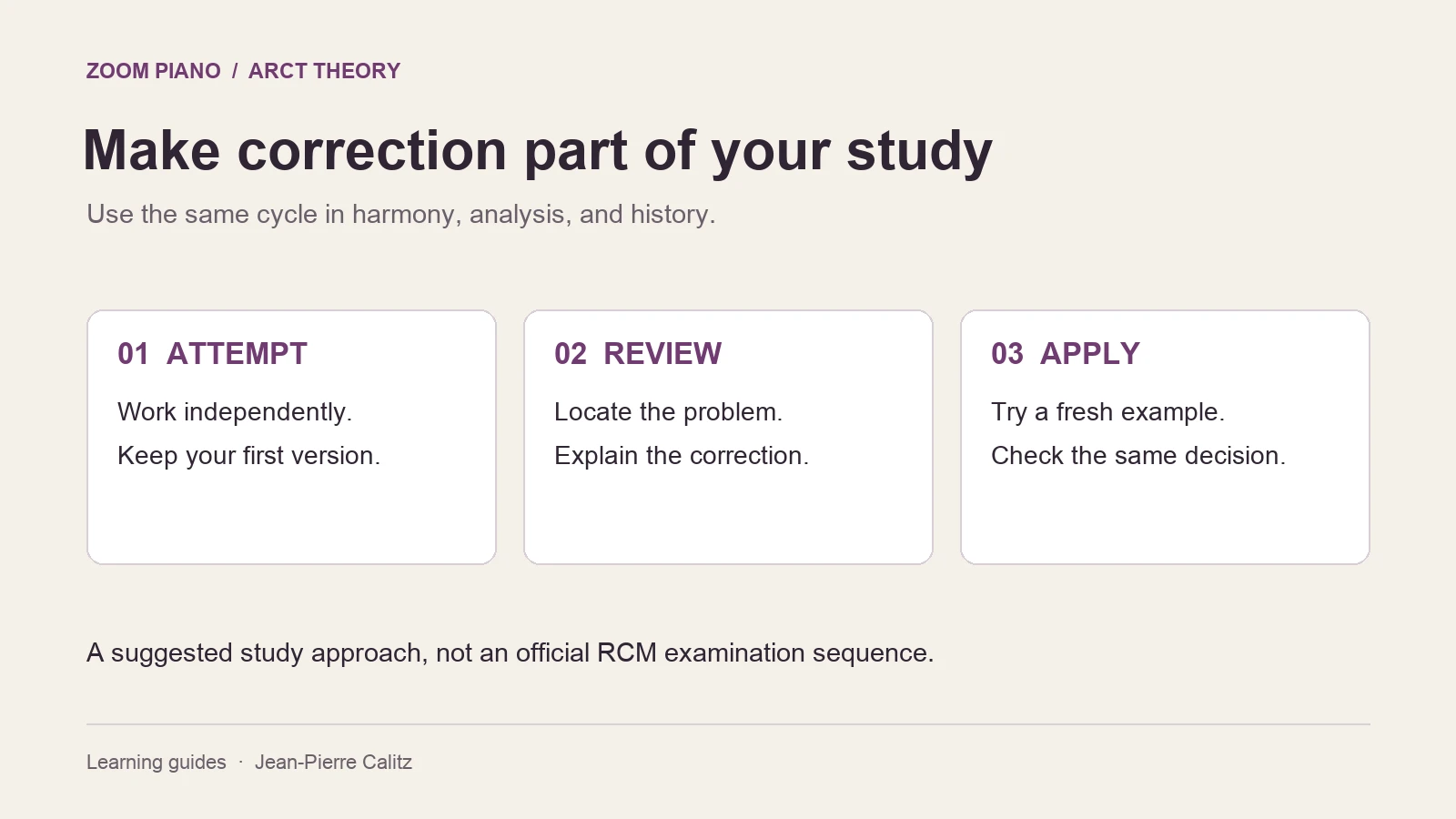
Organise study around a cycle you can repeat: attempt, feedback, correction, and a fresh application. New work fills the first step easily. The later steps need space in the calendar.
For each active subject, keep a brief error log with four fields: the task, the problem, the reason for the correction, and the next example you will try. Write “check the bass against each upper voice at this change” rather than “be more careful.” The next action should be specific enough to carry out.
You do not need to divide the week equally between subjects. Use your recent work to decide where more attention is needed. Preserve some contact with the other subjects, and review the balance when a recurring error is resolved or a new unit begins.
Move to timed practice after the method is dependable
Untimed practice lets you learn how to solve the task. Timed practice shows whether you can complete it under constraints. Keep both purposes clear when reviewing a result.
Start with a timed section, review it, and then work toward a complete practice paper or the appropriate format for your chosen examination. Check RCM’s current instructions before deciding the timing and conditions. Do not assume that practice in one exam format reproduces another.
Record where time went. Did one difficult question consume the session? Did you rewrite an answer because you had not planned it? Did checking begin too late? Adjust the method and try new material. Repeating a familiar paper can conceal the difficulty of making decisions independently.
Questions about ARCT theory preparation
Can I prepare through independent study?
Yes, but independent preparation needs a reliable way to check the work. Use fresh tasks and assess whether you can complete and explain them without a model answer. If you cannot explain why a solution is wrong or judge whether an analysis is supported, feedback is valuable. You can use lessons to focus on those gaps while continuing independent study between meetings.
How long will preparation take?
Make the estimate after reviewing your foundations and completing a representative unit, including corrections. Allow for the full remaining scope and practice under exam conditions. A fixed number of weeks cannot account for different starting points and schedules.
Can I take ARCT theory lessons separately from piano?
Yes. Zoom Piano offers separate RCM theory and history lessons through ARCT, online or in Vancouver. You can continue with your existing piano teacher.
Get feedback on the work that is holding you back
Dr. Jean-Pierre Calitz teaches the advanced RCM theory and history subjects. Include your subject, previous theory study, and any intended exam date when you enquire. Mention the type of question you find difficult so Jean-Pierre can discuss a suitable starting point. Current rates are listed on the lesson enquiry page. Enquire to discuss availability.
RCM sources checked October 22, 2026: the current syllabi listing, Theory Syllabus, and theory errata. These study exercises are suggestions, not official exam questions. Consult the current syllabus for the complete requirements.