You can know a page of RCM History notes well enough to recognize every sentence and still struggle to write about the music with the book closed. To prepare for History 9 or 10, give listening and writing a place in your week alongside reading.
Start with a required work. Can you name it when the recording begins halfway through? Can you explain its form, or compare it with another work without reaching for your notes? These small checks give you something useful to work on at your next study session.
This guide brings together the RCM requirements that affect your preparation and a suggested weekly routine. The routine can be adjusted to fit your course and available time.
First, check your RCM History exam format
The online and traditional written examinations cover the same syllabus, but differ in timing and question types. That matters when you choose practice materials.
| Exam | Time allowed | Preparation to include |
|---|---|---|
| Level 9 written | 3 hours | Handwritten descriptions of composers and works; score excerpts may appear. No listening test. |
| Level 9 online | 70 minutes | Listening identification and typed comparisons of composers or works. |
| Level 10 written | 3 hours | Handwritten discussion of works, styles, and genre development; score excerpts may appear. No listening test. |
| Level 10 online | 110 minutes | Listening identification, typed comparisons, and questions about musical development. |
These details come from RCM’s comparison of written and online History examinations. It also explains the essay expectations. Use the instructions for your chosen format when rehearsing an exam.
What changes between RCM History 9 and 10?
Level 9 History covers the Baroque, Classical, Romantic, and Modern eras. Biographical study is required for the composers shown in bold in the syllabus. Check the errata as well: Alexina Louie should be included in that group.
Level 10 History covers the Middle Ages, Renaissance, Baroque, and Classical eras, with an emphasis on the development of genres and forms. Detailed composer biographies are not required. Composers’ musical styles and contributions still matter.
See the Theory Syllabus, 2016 Edition, pages 37–45 and its errata for the full requirements. RCM continues to list this edition on its current syllabi page.
At Level 10, organize some of your notes by genre. Put the required examples beside one another and ask what changes in their scoring, texture, form, or purpose. This gives you material for a discussion of musical development. A folder organized only by composer can make those connections harder to see.
How to study the required works
Keep the syllabus open when you make your listening list. Check the exact movements or selections assigned. RCM strongly recommends listening to all required compositions and expects detailed knowledge of the prescribed music, including its context and structure. The preparation guidance is on pages 37–38 of the syllabus linked above.
For each selection, make a short set of notes that you can use while listening. Include the title, composer, required movement, and relevant dates. Add the instruments or voices, the form, and the associated terms. For vocal music, leave space for the text or dramatic situation.
Then choose a few moments you can locate in the recording. Where does the texture change? What returns? Which instrument carries the melody? A note such as “the opening material returns here” gives you something to listen for next time. Check your observations against the score and course materials before learning them.
Keep these notes brief enough to use. If a page becomes crowded, move the supporting detail elsewhere. You want to be able to follow the music without searching through paragraphs.
Once a selection feels familiar, hide its title and try identifying it from several places in the recording. After naming it, explain what gave it away. If you confuse two works, listen to them consecutively and write down the differences you can actually hear.
For score excerpts, try covering the printed identification and explaining the features you recognize. You can then check both the name and your explanation.
A weekly RCM History study plan
Here is a routine to try alongside your course. Allow roughly half an hour to an hour for each session, with extra time for longer listening or writing tasks. If you have fewer study days, combine sessions. Start with a manageable amount of new material and keep some time for earlier work.
Monday: choose a small group of topics
Select a required work or two and the terms that belong with them. Read the relevant material, then close the book and explain the main points aloud. Mark anything you could recognize on the page but couldn’t explain. Those are useful starting points for the week.
Add the works to a simple timeline so you can place them alongside what you have already studied. Use the dates specified in the syllabus.
Tuesday: listen with a purpose
Work through your chosen selections with the score or listening notes. Follow one feature at a time: the form on one hearing, changes of texture on another. At the end, listen to an excerpt from a previous week’s work with the title hidden.
If you miss an identification, listen again with the answer visible and find a detail that will help you distinguish it next time.
Wednesday: check the terms
Write a few definitions without looking them up. Beside each one, name an appropriate required work and explain how the term applies. This is also a good point to revisit similar terms that you keep confusing.
For example, make separate prompts for a work’s genre and its form. Check each answer against your course materials. Keeping those questions separate helps you notice when you have answered one in place of the other.
Thursday: write an answer
Choose a question suited to your exam format. Spend a few minutes planning, then write with the book closed. Early in the course, a careful paragraph may be enough for a session. As the exam approaches, practise complete answers within a time limit.
Read the prompt again after writing. Underline the sentences that answer it directly. If much of the answer remains unmarked, revise the plan before adding more facts.
At the weekend: revisit the gaps
Give yourself a short mixed quiz covering both this week’s topics and earlier ones. Include a little listening, some terminology, and a written response. Keep a record of errors with the corrected answer and the source you used to check it.
Return to a few of those errors at your next session. You may find that a term now comes easily but a comparison still needs work. Let that determine where you spend the time.
How to write a useful comparison
A comparison needs to move between its subjects. Two separate descriptions can contain plenty of correct information while leaving the relationship unexplained.
Before writing, put the two works or composers side by side in your notes. Read the question and choose only the features it asks about. If it asks about texture and performing forces, biographical detail will usually do little to help.
Take one feature at a time. Describe what happens in the first work, explain what happens in the second, and make the similarity or difference explicit. Name the movement or passage when you can. This gives the reader musical evidence to follow.
As a practice exercise, compare two required selections using only their performing forces and texture. Give yourself room for one paragraph. Then check whether each observation is accurate and whether it helps explain the comparison. This is a teaching exercise, not a sample RCM exam question.
For a question about the development of a genre, arrange the relevant required examples chronologically. Explain what changes between them and support each point with a feature of the music. Avoid making every work fit a single sweeping description of its era.
Teacher feedback is useful here. An answer can be factually correct yet leave out the part of the question that asks “how” or “why.”
Preparing for exam day
Look at a practice paper early enough to understand the tasks. RCM publishes Official Examination Papers for History. Work through individual questions as you learn, and save an unused paper for a later rehearsal.
For an online exam, also use RCM’s online exam demonstrations and preparation guidance. A printed paper can help you practise the subject matter, but it will not reproduce the listening component or the online interface.
As you approach your intended date, practise under the conditions you will actually use: type or write by hand, keep to the relevant time limit, and work without your notes. Leave enough time afterward to review the result.
Look for a pattern across several attempts. Can you explain terms accurately, recognize the music, and finish relevant answers? Which errors keep returning? If you know the material but run out of time, practise planning and completing an answer. If listening is the weak point, give it a larger share of the week.
Questions about RCM History
Looking ahead to advanced study? The ARCT theory preparation guide covers independent harmony work, score analysis, and writing about music.
How long does it take to prepare for RCM History?
It depends on how much of the course is new to you and how much time you can give it. To make a useful estimate, study a small section thoroughly, including its listening and writing tasks. See how long that takes, then allow time for the remaining material, review, and practice exams. Revisit the estimate as the course progresses.
Do I need to memorize dates?
Learn the dates called for by the syllabus. Put them on a timeline and connect them to the composers and works you are studying. Extra dates can be interesting, but check the required scope before spending hours adding them to flashcards.
Are History 9 and 10 required for an RCM piano certificate?
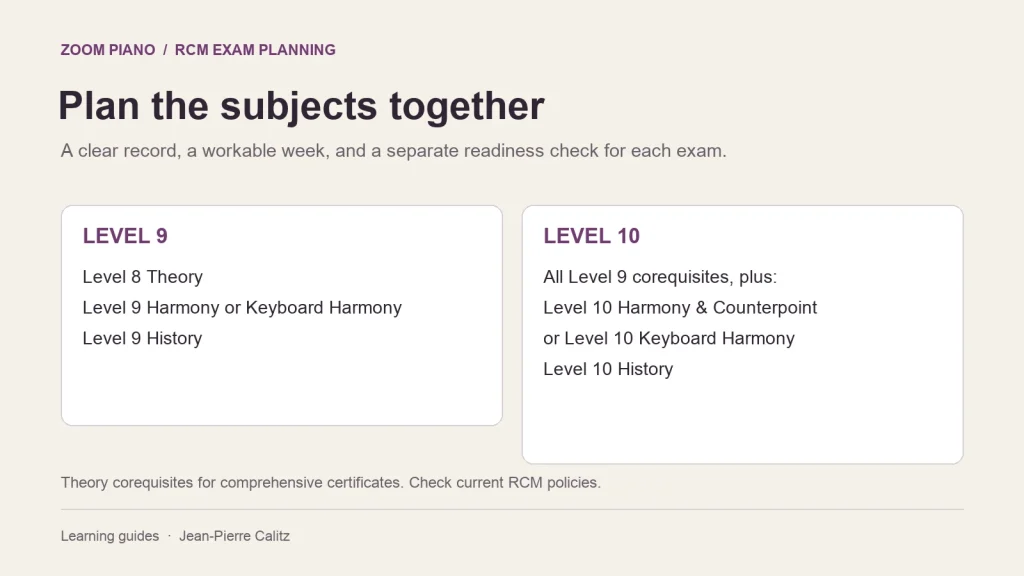
Level 9 History is among the theory corequisites for the Level 9 comprehensive certificate. The Level 10 comprehensive certificate includes both History 9 and History 10. The full requirements are on page 11 of the Theory Syllabus. Our Level 9 piano guide and Level 10 piano guide explain how history fits alongside the practical work.
Can I take History lessons while keeping my piano teacher?
Yes. Zoom Piano offers separate RCM theory and history lessons, online or in Vancouver. You can continue your piano lessons and study history as a separate subject.
Help with RCM History 9 or 10
Dr. Jean-Pierre Calitz teaches RCM theory and history through ARCT. If you would like help, mention your level, exam format, and where you are in the course. Ask about lesson availability.
Sources checked September 7, 2026: the RCM Theory Syllabus, 2016 Edition, its errata, and RCM’s online History examination guidance. The study routine is a suggested approach. Check RCM’s current instructions before registering.