To plan RCM Level 9 or 10, put the piano examination and every outstanding theory subject on one page. Check what you have already completed, identify the work still required, and choose exam dates only after you have tested the weekly workload.
A pianist can have a clear repertoire plan and still be unsure when to study harmony or history. The difficulty is often practical: three subjects compete for the same evenings, and the piano lesson is the only commitment already in the calendar.
This guide focuses on coordinating those subjects. For repertoire, technique, and musicianship requirements, use the separate Level 9 piano guide or Level 10 piano guide.
Which theory subjects belong in the plan?
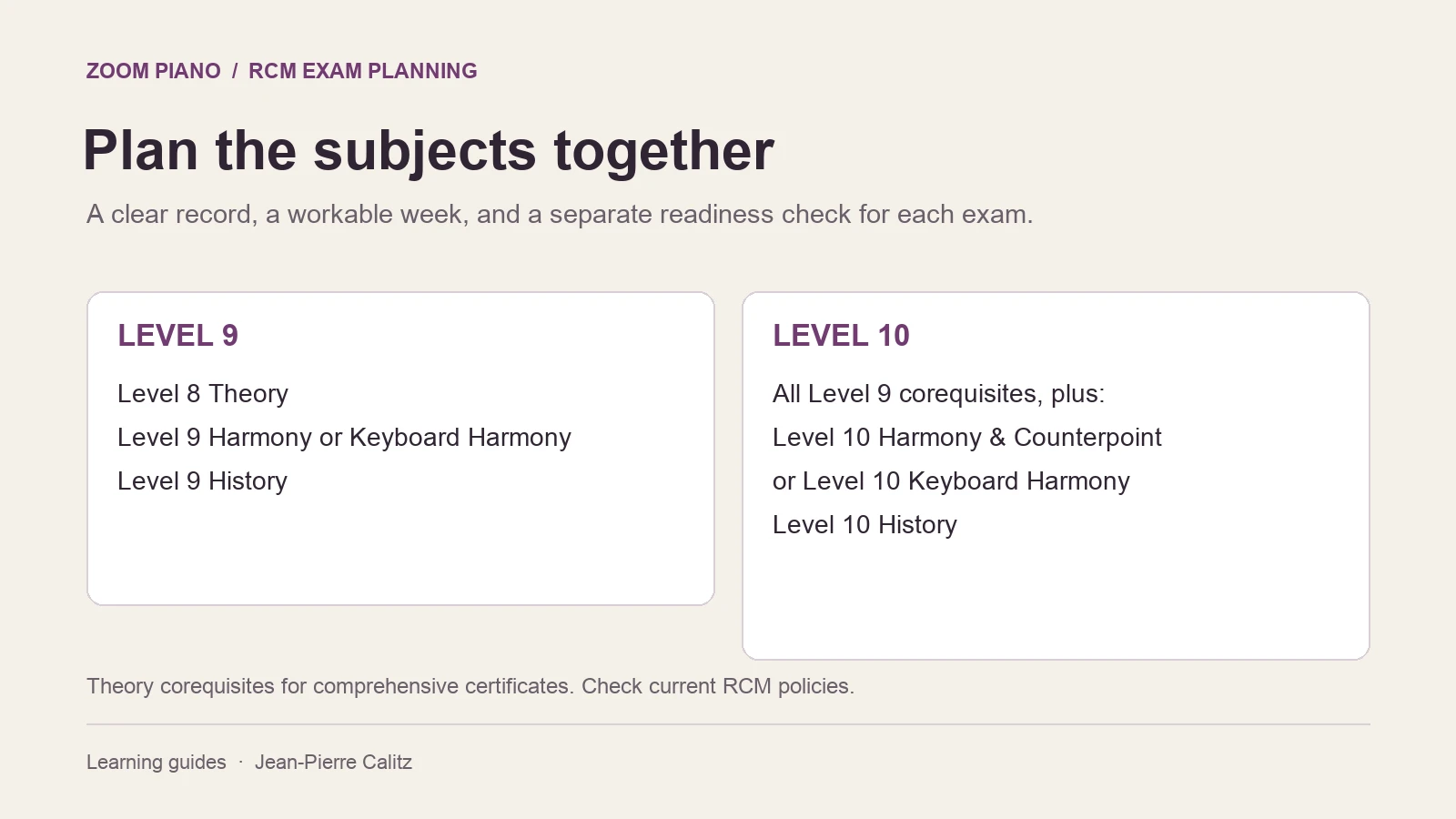
The comprehensive certificate combines the practical examination with its theory corequisites. The RCM Theory Syllabus, page 11, lists:
| Certificate | Theory subjects |
|---|---|
| Level 9 | Level 8 Theory; Level 9 Harmony or Keyboard Harmony; Level 9 History. |
| Level 10 | Level 8 Theory; Level 9 Harmony or Keyboard Harmony; Level 9 History; Level 10 Harmony & Counterpoint or Keyboard Harmony; Level 10 History. |
Read the Level 10 row as a checklist to reconcile with your examination record. A listed subject may already be complete. If your record uses an older course name, ask RCM to confirm how that credit applies before registering for another examination.
Start with your record, not a target month
Find the results for each examination you have taken. Record the subject, date, and result. Keep a separate column for anything you need RCM to clarify, such as an older credit or a certificate that has not appeared in your account.
Then give each outstanding subject a concrete next step. “Do history” is too broad to schedule. “Prepare one required work and write a closed-book comparison” is something you can put into a week.
| Subject | Credit status | Evidence | Plan |
|---|---|---|---|
| Piano practical (Level 9 or 10) | Completed / outstanding / confirm credit | Date and result: ______ | Target: ______ Next action: ______ |
| Level 8 Theory | Completed / outstanding / confirm credit | Date and result: ______ | Target: ______ Next action: ______ |
| Level 9 Harmony or Keyboard Harmony | Completed / outstanding / confirm credit | Date and result: ______ | Target: ______ Next action: ______ |
| Level 9 History | Completed / outstanding / confirm credit | Date and result: ______ | Target: ______ Next action: ______ |
| Level 10 Harmony & Counterpoint or Keyboard Harmony | Completed / outstanding / confirm credit | Date and result: ______ | Target: ______ Next action: ______ |
| Level 10 History | Completed / outstanding / confirm credit | Date and result: ______ | Target: ______ Next action: ______ |
For a Level 9 goal, use the piano row and the three theory rows through Level 9 History. For Level 10, use all six rows. Record the harmony route you have chosen. If you split the Level 10 practical exam, give each segment its own row and date. Leave a target blank until you have enough work to estimate it.
Example entry: “Level 9 History | outstanding | two required works reviewed; first written comparison needs checking | next action: revise that comparison before choosing an exam session.” Replace this illustrative entry with evidence from your own study.
Should you study harmony or history first?
Choose the order by looking at your starting point and available study time. If chord spelling and basic harmonic analysis still take considerable effort, begin by addressing those gaps. If those foundations are secure but the history course is almost untouched, history may need the larger share of your non-piano study time.
Try a small sample of both subjects before deciding. Complete a harmony exercise without referring to a worked answer. For history, study a required selection, close the notes, and write a short explanation of something you can hear in it. Review the work with a teacher. The result is more informative than how familiar the textbook looks.
Studying both subjects does not require preparing both examinations for the same session. You might concentrate on harmony while maintaining a modest history routine, then shift the balance after a clear milestone. Keep that distinction visible in the plan.
Choosing written or keyboard harmony
Compare the actual tasks in the two syllabus sections with your teacher. Enjoying piano performance does not, by itself, tell you which route will suit you. Try a representative task from each before buying materials or committing to an exam. Make the choice around how you can best develop and demonstrate harmonic understanding.
Build a week you can repeat
Start by marking school or work, piano lessons, existing practice, and other fixed commitments. Add theory to the time that genuinely remains. If the plan depends on using every free evening, it has little room for an ordinary busy week.
Here is an illustrative pattern to adapt. It is a planning exercise, not an RCM study-time requirement:
- First harmony session: attempt a small set of new problems and mark the points where you needed help.
- Second harmony session: correct the work, explain the changes, and try a fresh example using the same idea.
- First history session: listen to one required selection with the score or course materials and make brief notes.
- Second history session: answer a focused question without notes, then check the accuracy and completeness of the answer.
- Weekly review: compare planned work with completed work and decide what changes next week.
Keep piano practice in its existing place while testing this pattern. After two ordinary weeks, ask whether the work fitted, whether corrections received attention, and whether any subject repeatedly disappeared. Adjust the scope before adding more assignments.
For the listening and writing component, the History 9 and 10 study guide provides a more detailed routine.
What if the piano exam is approaching but theory is behind?
Consider a hypothetical Level 10 student whose repertoire is progressing well but whose History 9 preparation is incomplete. Adding two history courses and advanced harmony to every week may produce an impressive calendar with little completed work.
A more useful first step is to establish the remaining History 9 workload, protect the piano preparation already under way, and decide what can realistically be completed next. The student and teachers can then discuss separate examination windows. The next milestone is a completed, reviewed unit of work, rather than a full calendar of new assignments.
If piano and theory are taught by different teachers, give both the same summary of completed credits, current assignments, and proposed dates. Ask where the workload is likely to become heaviest. That conversation is especially useful before adding another subject.
Check completion windows before registration
For a split Level 10 practical examination, the Piano Syllabus, page 119, specifies two years from the initial segment for both practical segments and any supplemental examinations, and five years from that initial segment for theory corequisites.
Those are completion limits, not suggested preparation times. Before selecting dates, consult RCM’s current syllabi and policies and confirm how they apply to your examination record. If ARCT is your next goal, also check its entry requirements before treating a Level 10 plan as complete.
Decide readiness from completed work
A finished workbook is useful evidence of coverage. It does not show whether you can solve an unfamiliar problem independently. Before registration, include practice under the conditions of your chosen exam format, with enough time afterward to correct weaknesses.
For harmony, look at whether the same error returns in a new exercise. For history, check whether your answer addresses the question and supports its points with accurate musical detail. For piano, review complete performances and supporting skills with your teacher. Use those observations to revise the dates.
Questions about coordinating RCM exams
Do all the subjects have to be prepared for the same exam session?
No. The subjects can be completed in different examination sessions. Plan each around readiness, while checking the completion windows that apply to your certificate and examination record.
Can I keep my piano teacher and take theory separately?
Yes. Zoom Piano offers separate RCM theory and history lessons. Bring your current plan so the subjects can fit around your piano study.
Make a plan for your outstanding subjects
Dr. Jean-Pierre Calitz teaches RCM theory and history through ARCT. In your enquiry, include your target level, completed subjects, and any proposed exam dates. That gives Jean-Pierre a useful starting point for discussing lessons. Current rates are listed on the lesson enquiry page. Enquire to discuss availability.
RCM sources checked October 22, 2026. The schedules and examples are suggested study approaches, not RCM requirements or completion guarantees.